Showing posts with label Frances O'Grady. Show all posts

Tuesday, 24 September 2013

#Lab13 - Responsible Capitalism and Workplace democracy. Giving workers a real voice

This interesting lunctime fringe had been sponsored by the Fabians, TUC and PIRC. Chaired by Seema Malhotra MP.

TUC General Secretary Frances O'Grady started off by saying some of her members think that "responsible capitalism" is an Oxymoron! But her main point was why is corporate governance in the UK so peculiar and out of step with the rest of Europe?  Where employee representation on company boards is common place.

We need to rebalance Labour and Capital. Frances quoted a terribly condescending and even insulting comment (which she described as "patronising twaddle") from the CBI about why in the UK British employees aren't good enough to being represented on boards.  Workers keep being told that they are the organisations "greatest assets". Yet the arguments being made against employee representation remind her of those made in 19th century against getting rid of the property qualification in order to vote.

Chuka Umunna MP believes that it is all about balance. Do we want a mixed or a laissez faire economy? Leading businesses started talking about this debate before we did in Parliament. Things have got to change. Need to promote the long term. Value investment in people and skill up. Look at the damage done to BP reputation and profitability after the oil disaster. It is in companies self interest to have good governance models. 

Tom Powdrill from PIRC thought that the governance mascot was Lord Myners. Why did shareholders not stop the banks from destroying themselves? Excessive executive pay levels are being driven to the levels found in financial markets. Since oversight is not by shareholders but by fund managers and hedge funds who naturally will think such levels are appropriate. Need a dose of reality. Tackle the problem up stream before a decision is made.  UK Companies already invest in Europe where employee representatives are widely accepted -so why don't they support similar models over here?

Nita Clare from the IPA (see previous post here) was Tony Blair's advisor on trade unions and before that a national officer for unison for 17 years. Good businesses know the value of stakeholders. The CBI quote is now quite old fashioned.  She stressed the importance of the supply chain to business. If there is a fire in a Bangladeshi factory it is no use saying "nothing to do with us".

There has been a death of deference and trust at work. 60% of employees surveyed said they don't trust managers. Management style is critical. If you have a culture of fear in any organisation, private or public, then it will fail. The Social partnership approach in Germany will be difficult to adopt in UK

My question to the panel was similar to the one I made before was how is it that I am an employee representation on a £900 million pension scheme and I sit on a joint committee on health and safety that looks after the safety of thousands of workers but I cannot sit on the management board or remuneration committee of my organisation?

Wednesday, 24 July 2013

The £35 Billion of Pension Tax Relief being Ripped off by the Rich?

The British State quite rightly gives significant tax relief to subsidise pension provision. So why is it that recent research shows that the richest 1% of our society get 17% of all tax relief while the majority of basic rate tax payers only get less than a 1/3rd?

Why do the low paid have to contribute more to their pensions than the high paid? The person who cleans the Chief Executive's office has to pay more out of their income for their pension than their highly paid boss. In an era when there was decent guaranteed pensions this might have been a price worth paying but now it is simply a rip off of the poor for the rich.  The £34 billion of pension tax relief should be shared fairly.

BTW Why don't the right wing groups such as the Tax Evaders Alliance kick off about this? Is it because many of their funder's benefit from this tax rip off?

"Commenting on new pension tax relief research...by the Pensions Policy Institute (PPI), TUC General Secretary Frances O'Grady said:

'Tax relief is an important way to encourage pension saving but the benefits are currently far too skewed towards the very wealthy.

'It cannot be right that basic rate taxpayers make the majority of all pension contributions but receive less than a third of the total tax relief budget. Additional rate taxpayers, who earn at least £150,000 and represent the top one per cent of earners, receive 17 per cent of all tax relief.

'The PPI report also highlights a serious flaw in the current tax relief system, with many people receiving relief at the higher or additional rate, but then becoming basic rate taxpayers in retirement.

'Hundreds of thousands of wealthy pensioners are likely to be benefiting from this anomaly, having effectively avoided income tax on a portion of their earnings during their working life.

'With the cost of pensions tax relief set to rise to £35bn a year, the case for a simpler, fairer system is stronger than ever.'

The report analyses a number of proposals to reform pensions tax relief, including the introduction of a flat rate for tax relief and a cash limit on lump sums in retirement that are eligible for tax relief.

Frances O'Grady added: 'The TUC fully backs the proposal to set a flat rate of tax relief at 30 per cent. This would transfer some of the benefits from the very wealthy to lower and middle income earners without any additional cost to the Exchequer.

'Tax relief on lump sum payments is even more skewed towards the super rich, with the two per cent of lump sums worth over £150,000 accounting for almost a third of all expenditure.

'The government must consider a cash limit on lump sum tax relief. A limit of £36,000 would halve the cost of tax relief without affecting the vast majority of pension savers.'

Key facts from the PPI report:
More than half of all pension contributions are made by basic rate taxpayers, who receive less than a third of pension tax relief.
Higher rate taxpayers contribute only 37 per cent of all pension contributions yet receive the majority of tax relief.
Additional rate taxpayers contribute 9 per cent and receive 17 per cent.

- The PPI research can be downloaded from www.pensionspolicyinstitute.org.uk - The TUC has part-sponsored the PPI research, along with Age UK, Partnership and The Institute and Faculty of Actuaries

Sunday, 14 April 2013

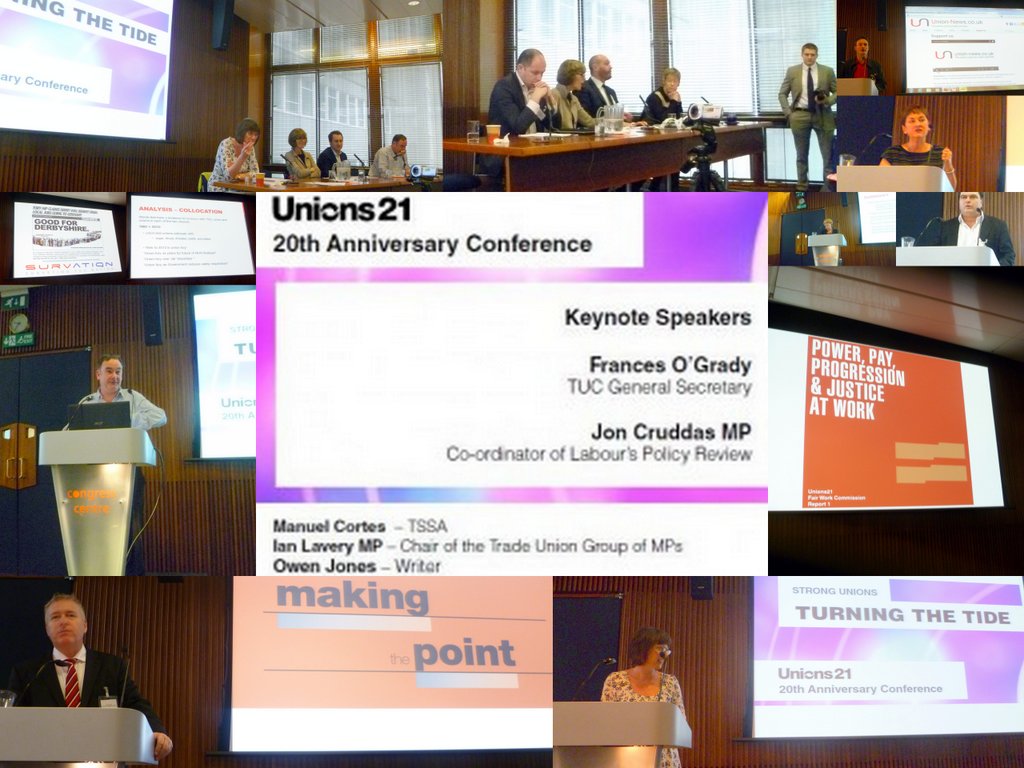
Unions21 Conference 2013


This post is a little late but is about the excellent Unions21 20th Anniversary conference, which took place on International Women's Day 8 March last month at Congress House. I was there in my personal capacity.

The first speaker was its director, Dan Whittle, who reminded everyone that Unions21 was set up to support the miners during their strike in 1983.

Next was Jon Cruddas MP who gave his usual individual slant on the Labour movement. He pointed out that the Labour Party had always lost elections in the past after crisis's in capitalism.

He thinks that Labour has changed since 2010 and is now having a conversation about workers rights, board representation, reform of Banking, infrastructure, housing and having a real partnership with the unions.

As an aside he said that before he had been appointed to co-ordinate the Labour Party policy review there had been 40 different policy groups including one on combating loneliness which had been inquorate and had never quite manged to meet. Now there were only 3 groups.

New General Secretary of the Trade Union Congress, Frances O'Grady, described Unions21 as the Labour Movement equivalent of the Taxpayers Alliance, except they had more brains and less money. She called for a return of wage councils especially for sectors that can afford more than the minimum wage. Even the shock troops of capitalism such as the IMF recognise that we need to increase wages to increase demand in the economy.

The City has acted as one armed bandit in pushing up the pay of Chief Executives. There is no real checks and balances to hold them to account. Capitalism has reformed but the trade unions have not. We need to take a long hard look at ourselves. Strong trade unions are necessary for both wings of the Labour Movement to build one nation.

Other speakers were Lesley Mercer, TUC President who pointed out that the Australian trade unions had managed during the last general election campaign to take employment rights from being a non issue politically to the 2nd most important and this was probably responsible for the narrow Labour Party victory.

Carl Roper from TUC spoke about the clear link between the decline in collective bargaining and greater income inequality and that the unique selling point of union reps is that they are independent of the employer. Union reps actually save employers money. The government is suppose to love volunteers but the voice of employers who value reps and the way we deal with everyday difficult problems is absent.

Community John Park attacked the SNP Scottish Government for failing to ensure that (tax dodgers) Amazon used the £5 million subsidy they received to open a new warehouse to create permanent jobs. Instead nearly all the new 800 jobs were subcontracted to 3 employment agencies who employ workers on poorly paid, insecure 0 hour contracts.

In a presentation on "The future for union image" by Dr Brian Walker & Lesley Jeffries. Linguistic media data from 1993 and 2012 were compared. In 1993 unions were linked with disputes and aggression. All references were male. While in 2012 unions were linked with money and pay. Unions are still labelled as being angry, aggressive with reference to “Bosses and Barons”. Press ignore the fact that individuals can be taxpayers and union activists. Will Frances O’Grady be labelled a Baron?
Christine Payne from Equity spoke about her union realising that instead of the union telling its members how good the union was that it is better to have members telling members their stories.

Scarlet Harris, TUC Women’s officer, reminded us that more women are in unions than men. Unions have changed but only 25% of General Secretaries are women. There is still lots wrong and there exists a macho culture in too many unions. Unless we can keep our own house in order we cannot change society.

Ian Lavery MP is the Chair of the Trade Union Parliamentary Group (I once stayed at the same B&B with Ian at Party conference and had some interesting conversations with him). As a former coal face worker, he was on strike for 12 months during the miner’s strike and took over as President of the NUM from Author Scargill. He still sees himself as a Trade Unionist first and his role is to reduce the gulf between the trade unions and the Labour Party.

How do we get back the millions of trade union members and Labour Party voters both parts of the movement has lost over the years. We have no divine right to demand people to join. Need to attract people, explain and reach out. Politicians must be seen on the side of working people. He still sees himself as working class even though as an MP he earns £65k per year. Class is not means tested. We want more people with actual work experience, from the shop floor into Parliament. No more elites parachuted into CLPs as MPs. It is essential that the Labour is not just seen as being less nasty than the Tories. Together the Party and the trade unions can reframe the political argument.

Journalist Owen Jones reminded everyone that while the numbers of members of trade unions is down to 50% in public sector and 14% in the private sector, trade unions are still by far with 6 million members the largest democratic organisation in the UK. Trade unions also need to follow changes in workforce. There are now more workers in call centres than use to work in the coal mines.

John Slinger from “Pragmatic Radicalism led a "Change the Nation: 10 ideas, campaigns & wider social concerns unions can make common cause". This was 10 ideas pitched by individuals in 90 seconds with a 90 second Q&A from panel and floor. This was great fun.

There was an UnionHome award on the best post on the blog which was presented by Tim Lezard of Union News to Simon Sapper.

The last presentation was a fringe by Polling experts Survation on unions who have used opinion polling to argument their campaigns.

This was my first Unions21 annual conference and I was really impressed. This was just the sort of stuff that all unions should be thinking about and debating. My question to one of the panels about "whether or not the traditional Anglo-American trade union model that all bosses are the enemy is broke but what do we do about those bosses who do think unions are the enemy" got a little lost in translation but my fault for being too wordy.

While Unions21 is not affiliated to the Labour Party and there was plenty of criticism (often justified) of the Party during this conference. It was largely constructive and aimed at improving the relationships of both wings of the Labour movement rather than just moaning and finger pointing. I shall look forward to Unions21 Conference 2014.

(apologies for missing out some contributers out since I had to dash out of the hall a few times to deal with member problems)

Sunday, 10 February 2013

Unions21 Anniversary Conference 2013

Date: 8th March 2013
TUC Council Chamber, Congress House, Great Russell Street, London

To register CLICK HERE.

STARTS 9.00 am with Keynote Speakers:
Frances O'Grady - TUC General Secretary
Jon Cruddas MP - Co-ordinator of Labour's Policy Review
Other speakers: Sue Ferns (Chair), Owen Jones - Writer, Manuel Cortes - General Secretary of TSSA, Scarlet Harris - TUC Womens Officer, Ian Lavery MP - Chair of the TU Group of MPs, Ros Bragg - Director of Maternity Action, Sam Smether - Grandparents Plus, Laura Bates - Everyday Sexism.

This all-day event is the 20th Anniversary Conference of Unions21. Lunch is provided. A £50 delegate fee can be paid via paypal or an invoice sent to you or your union after the event. For more information email dwhittle@atl.org.uk

AFTERNOON SESSION 1: Sharpening the Sword of Justice
FORMAT:

- 90 SECONDS PER SPEAKER TO PRESENT A POLICY IDEA (up to 15 speakers)

- 2 MINUTES Q&A PER POLICY

- ONE VOTE

- ONE TOP POLICY

YOUR CHANCE TO PITCH A POLICY IDEA TO HELP UNIONS TURN THE TIDE….

Union campaigns have changed Britain for the better. Unions are listened to by politicians and employers. In this session we’ll hear from advocates for a variety of issues that could be the focus of the next big campaign for unions. Ideas will be pitched in 90 seconds, followed by up to 2 minutes of Q&A. The audience will vote on which idea or cause they think should be Top of the Policies.

To have the chance to present your 90 second policy idea on the on the day, 
Send to PragRad Chair, John Slinger john.slinger@pragmaticradicalism.co.uk

Sunday, 4 November 2012

Class: Parliamentary Launch "Why Equality Matters"

Collage is from the Parliamentary launch last Wednesday evening of "Class" The "Centre for Labour and Social Studies". A new "left" think tank.

The launch featured its latest report "Why Equality Matters". Which is a more populist and accessible version of the book "The Spirit Level - Why Equality is better for everyone". 

The meeting was packed with loads of Labour MPs. Including Stephen Timms from East Ham.

Steve Hart from Unite chaired the meeting, Emily Thornberry MP spoke first, then we had John Trickett MP, Owen Jones, Professor Richard Wilkinson and new TUC General Secretary Frances O'Grady. Check out my twittering here on the event (31 Oct).

I asked the question about whether we were really preaching to the converted here tonight when we should be asking what actual policies will be needed to bring about a more equal society. Should we be honest with the electorate, that everyone will have to pay more in taxes not just the super rich, to bring about a society that benefits everyone? (such as truly affordable housing and childcare)

Owen Jones responded by saying that at first we we need to start with a tax on the rich and make sure that they do not evade their taxes, then we could be more ambitious. The wealth of the Sunday Times "Rich List" has grown during this "recession" by more than the total sum of the deficit.

Frances O'Grady was fiery and passionate in her response. Growth in real wages is key in reducing inequality and recession. UK companies have reduced wages and accumulated £750 billion in reserves. No wonder we have no demand in our economy.

Afterwards I met up with my best ever blogging mate, Dave Stroppy, (nee Osler) and we went with UNISON comrades to sort the world out at the Red Lion.

Middle picture hat tip Seph Brown

Monday, 29 October 2012

Austerity: What next after #Oct20?

A rather intense (to be polite) picture of me speaking at Saturday's SERTUC Council meeting at Congress House. The New TUC GS Frances O'Grady had just made a cracking speech.

I was supporting the GLATUC motion on "Austerity".

"President, Council, John Gray UNISON speaking in favour of Motion 1. I will try and keep this short since much of what I wish to say has already been said. But "What next" after Oct 20 is the key issue for the Labour Movement. We must firstly continue to educate and inform our members in the Great Battle of Ideas over the Economic Alternative to Austerity.

Despite the magnificent march of last weekend, I am reminded of past reports by our own Regional secretary, Megan, to this Council and the comments you have just heard from Frances, that a majority of trade union members still think that "Austerity" is necessary, the "Cuts" are necessary and there is "No Alternative".  

While we can turn out many of our activists and their families on a Saturday to protest unless we can also persuade our rank and file members, their families and their friends that there is a different way to run our country, then we are simply not going to be able bring about change.

Council, the truth of the matter is that we have a huge job of work to do. We need to not only educate but to  organise and unionise. Especially in the private sector where 85% of the workforce are not only not in any union but many of them have simply no comprehension or understanding of unions. They are Thatchers Grandchildren.

Perhaps Council, one other practical way forward is to bring to peoples attention that there are already examples of successful countries such as Sweden or Norway which are run differently. Frances mentioned "The Spirit Level" research that everyone is better off in more equal societies. Where there is greater income equality, greater trade union density and greater worker involvement in the wider economy.

Arguably Council, there is already out there A Future That Works; and it is only a ferry ride across the North Sea. Council, please support this motion. 

Saturday, 27 October 2012

Frances O'Grady at SERTUC Council

This morning I went to the Trade Union Congress Southern & Eastern Regional Council (SERTUC) as an UNISON delegate at Congress House.

Our keynote speaker was Frances O'Grady, the General Secretary (elect) of the TUC. This was the first time in living memory that any TUC GS had addressed our Council.

Despite being under the weather with a cold, Frances gave a cracking speech. Wide ranging, thought provoking, honest, passionate, but pragmatic.

I base this post on my tweets made during her speech with the usual disclaimer for thumb fumbling haste and any mistakes or omissions are my responsibility.

She firstly greeted us as "sisters, brothers and fellow plebs! SERTUC region is important since 26% of all trade union members live here. We need to act smart and inspire people. Work with different community groups. Even the Women's Institute. Our job is to turn opposition to Austerity into a mass movement and in the long term achieve a better, fairer society.

We must tackle growing income inequality. The top 10% are 500 times richer than the bottom 10%. While the City Spivs get massive bonuses the lowest paid have food banks. This in the 7th richest society in the world.

The "Spirit Level" book proves that such inequality is bad for everyone. We want tax justice. We want Starbucks, Amazon to pay their taxes.

We need a change in economic policy. Even the IMF, which is not known for being a left wing organisation, recognises that workers need to have money in order to buy things to create demand and jobs.

What we want is not only a transfer of wealth but a transfer of power. Why can't we have employee representatives on Company remuneration committees?

It is understandable, but we must be careful about the big danger from a decline in trust in politics. If people lose hope, it could be very bad for us and progressive politics. We have to be very careful about our language.

Any further mobilisation must be a demonstration of strength not weakness. We have to be clever and not burn out our members.

There are arguments that a general strike could be legal but this depends on European law and anyone with any experience of this, knows it takes years for these cases to be decided. Firstly we have to ask our affiliates if there is an appetite for action.  Also, if we have a general strike without a ballot, we have to be honest with people, that they could be dismissed if they take part. Union funds could also be sequested by Courts.  Any general strike cannot just be a public sector strike. It must be supported in the private sector.

Frances finished by making it clear that this is a weak coalition government and that there is widespread fear even in the middle classes, about such things as youth unemployment, housing shortage and the sharks such as Virgin, circling our NHS. If we go about it in the right way we can and will give this government a good kicking.  

(Check out my twitter account for 27th October for a fuller report of Council. I did speak on the Austerity motion which I will post upon separately) 

Sunday, 16 September 2012

TUC 2012: the long march towards the workers idyll?

A week ago the 2012 Trade Union Congress opened in Brighton. I was there as a UNISON delegate although I missed the final day (Wednesday). Here are some random and personal thoughts on this year's Congress.

I suppose the yardstick for deciding if it was successful or not is whether the movement is in better shape after Congress now than before?

Did "ding dong Thatcher gone", heckling Ed Balls and calls for a national strike wreck our image and credibility? or did the election of Frances O'Grady, the consensual chairing of El Presidente Kenny and the lack of blood on the carpet mean that a workers idyll is just around the corner?

Neither is true. While I have my doubts that it is indeed possible or desirable to call a national strike, the threat of it drew more media attention to Congress than even Liz Cameron's savaging of Ed Balls.

The media are even more obsessed with strikesthan the most enthusiastic of ultra left newspaper sellers. The ding dong row was of course a complete and utter ring wing media invention that had nothing to do with the TUC itself.


I do think that Frances O'Grady as General Secretary is a huge advance for the movement. Apart from her many personal qualities and with all due respect to all the good work carried out by Brendan Barber and his predecessors, we finally have a GS that looks and speaks like one of our members and not just one of our activists.

It also seemed to me that the speeches and fringes at Congress this year were more hard headed and realistic than in previous years. There was less grandstanding and pontificating. We still talked to the converted too much and there was some completely off the wall wishful thinking but the starkness and enormity of the threat that faces us concentrated many minds.
 
We are against the wall. We have less than 6 million members out of a total workforce of over 30 million. While austerity, redundancies, pay freezes and attacks on employment legislations mean we either get our act together and organise effectively or we turn into just another protest movement. This makes me think that Congress was a "success" in these terms although it is only the start of a long, long road. During which we need to consider what works and what doesn't?
 
Is the traditional Anglo-American trade union "model" (aka the bosses are all bastards)"fit for purpose"? Do we continue to not want to dirty our hands by providing welfare or financial services pensions to the general public like they do in countries with much greater union density (and income equality)?  

Hat-tip caption Hope Not Hate

Monday, 10 September 2012

TUC 2012: Frances O'Grady during Transport debate

I like this picture of the new TUC General Secretary, Frances O'Grady, making a statement on behalf of the Council during the debate on transport.

There is going to be a lot of interest in Frances as the first ever female head of the TUC. Not just the media looking for a new angle. But I'm not sure that the Guardian (bless it) was really right when it said the average trade union member is now a young female graduate (surely not?  if that was the case then the majority of the 545 delegates at our democratic Congress would of course be women!).

The new General Secretary of the European Trade Union Confederation (ETUC), Bernadette Ségol, also addressed Congress today.   She looked to Frances during her speech and said  "I now look forward to working with Frances. Tom Jenkins explained to me that, in London, busses were late, but then three of them arrived at the same time. Well, like London busses, women General Secretaries have been late in making it, but you are getting them now. Enjoy".

Sunday, 9 September 2012

Trade Union Congress 12: Sunday afternoon

Picture of UNISON delegate Gordon McKay seconding the composite motion on "Trade Union and Employment Rights" at the start of Trade Union Congress 2012. Gordon finished his speech by offering some rather rude travel advice to Tories.

"Congress is the policy making body of the TUC, and meets each year during September. Each affiliated union can send delegates to Congress - the larger the union, the more it can send. At Congress 'motions' (resolutions for debate) are proposed and discussed. These form the basis of the TUC's work for the next year".

You can check out the TUC blogs and tweets here.  The hashtag is  #tuc12. You even watch it live online.

The UNISON delegation had a pre-meeting at 3pm where we decided whether to support or not motions up before Congress where we haven't so far made a decision. Conference started at 4pm. There was a lobby outside Congress and delegates were greeted with the traditional welcome chant "TUC get off your knees... General Strike Now".  

The President of Congress, GMB General Secretary Paul Kenny, chairs the meeting. A more relaxed and tolerant chair than others I have seen over the years. He even gently told off Unite GS Len McCluskey, for speaking longer than he should have done.

Composite 4 is on "Illegal Corporate Bullying" and describes the secret "blacklisting" of trade union and safety reps by the construction industry.  Which meant that many activists were refused employment for many years if not decades. Motion 16 on "Hidden Courts" was about concern over Justice and Security Bill.

5pm Paul Kenny addressed Congress and reminded us of the role of his predecessor Will Thorne in the formation of the unions. People should be proud of unions and the social justice they have created. Paul introduced the new TUC General Secretary Frances O'Grady and gave thanks to the outgoing GS Brendan Barber.

At UNISON conferences we leave the teasing of the President until the end. Congress starts at the beginning. Paul was praised for being the "best ducker and diver in the trade union movement" by Gail Cartmail.  A point agreed with relish by Bob Crow who also thought Paul despite being a Millwall FC fan was a "decent bloke".

Battery in my laptop now running out.  Will try and post further tomorrow.